The Number of Areas Where DST and Outlandish Time Zones
Are Having Harmful Impact Is Stunningly Large
Reasons for rejecting DST and distorted time zones (DST-TZ) are many. Jumping to a few of the following may interest you.
From Heart, to Income, to Real Estate, & More. Current DST-TZ seasons of dark winter mornings are producing greater harm than is commonly known. For example:
- Chronic Disease Medical Cost
- The Unfolding of Spring 2026
- Teenagers Harmed
- Reduced Personal Income in Twenty-Six States
- Suicide
- The Dark Morning Chronic Disease Model
- University Rankings
- Permanent DST
- Longevity
- Circadian Impact on Real Estate, Towns & Cities
- The Choice Facing Us
Excessively long DSTs and inappropriate time zones (DST-TZ) have damaged health and the economy, especially in the Midwest (and points directly south of it). Circadian-related, public-health harm is abundantly evidenced in accelerated chronic disease rates produced by DST and inappropriate time zones. With the aid of the three interactive maps available here, rather than seeing only a region as a whole, you can quickly get a picture of five DST options that apply in your home county (Map #1, #2, #3). As you will see, some counties are more heavily impacted than others.
On point, Google AI opens the door: "Dark mornings"— defined by waking up before sunrise — act as a significant trigger for chronic disease exacerbation, primarily through the disruption of the body's circadian rhythm. The "cost" involves a combination of increased mortality risk, severe health complications, reduced cognitive function, and substantial economic burdens. ... Human bodies rely on morning light to set the metabolic and hormonal rhythm for the day. When waking in the dark, the body fails to properly transition from sleep to alertness, leading to chronic stress, fatigue, and lower productivity.
In this analysis, for high granularity and accuracy, dark mornings for all 3,000 counties in the continental United States are defined by the percentage of days in a year with sunrise after 7:00 AM. NOAA sunlight data is reliable and readily available. Looking at the underlying interactive map data, we find that under natural, unadulterated conditions dark mornings in the continental United States, at the median, do not exceed 69 days, 2.3 months per year, 19% of the year — or at the absolute maximum, 37% of the year (135 days). It is only misguided human intervention that now causes them to vastly exceed these levels.
With the current DST, we have a median 5.6 winter months of dark mornings vs. the 2.3 months we would naturally have had. This is a price of DST and corrupted time zones.
In the interactive maps here, wherever you see days of dark mornings exceeding 37% per year, we are living in conditions that would not have existed in nature — the greater the departure from 37%, the greater the abnormality. To function at our peak, we commonly need dark mornings to remain less than 37% annually, substantially equivalent to permanent standard time.
Thirty-seven percent dark mornings (DM) is a threshold of frank abnormality, above which chronic disease rates and costs accelerate, hand in hand with biological harm. The 37% target range can be seen in this graph preview, which later is discussed in detail.
Current DST and Its Dark Mornings
Create High Chronic Disease Costs
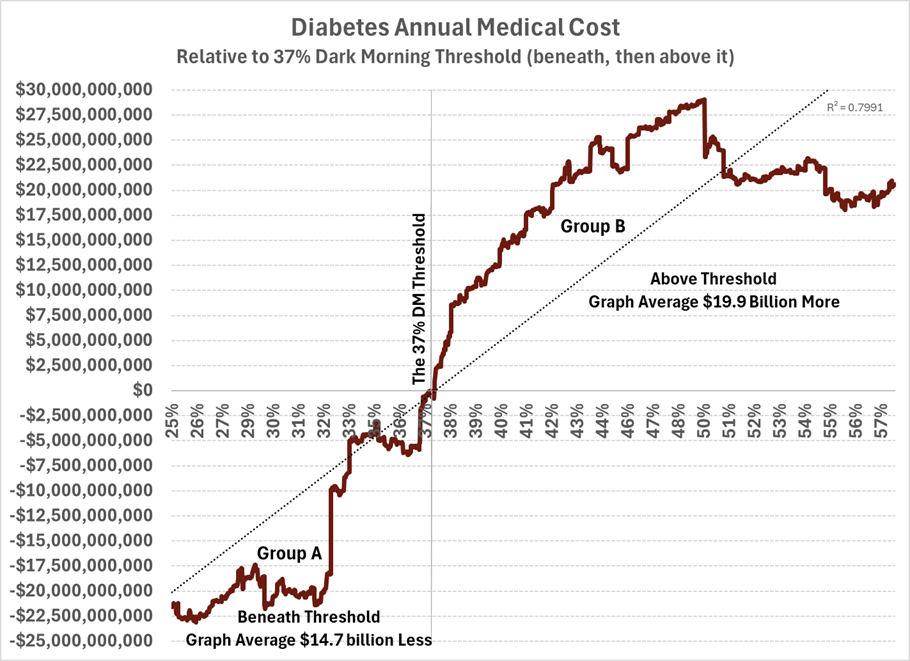
DST costs are routinely underestimated, quietly absorbed, and rarely mentioned. High Group-B diabetes costs are just one of many large, yet rarely-mentioned DST-related costs.
Step by step, this graph shows progressively growing medical cost as percentage of dark mornings increase.
Because of circadian influence, throughout all major chronic disease categories, very low medical cost exists only when dark mornings are few. A low percentage of dark mornings signifies less extreme changes in sunlight exposure — a low circadian burden.
Group A is beneath the 37% DM Threshold. Group B is above it.
DST and distorted time zones alone create the colossal Group-B expenditures shown in this graph and table.
Wherever in the maps you see percentages of dark mornings lower than 37%, you see conditions roughly equivalent to Permanent Standard Time (Group A). The Group A health benefit of Permanent Standard Time is obvious.
| Diabetes Cases | Diabetes Cost | |
|---|---|---|
| Total | 27,335,314 | $413 Billion |
| Group A | 11,796,180 | $178,224,490,814 |
| Group B | 15,539,134 | $234,775,513,976 |
| Difference, Group B-A | 3,742,954 | $56,551,023,162 |
| Per Patient Average Annual Diabetes Cost | $15,109 | |
| % of Group B That Can Directly Benefit | 5.9% | |
| People Directly Benefiting | 911,600 | $13,773,055,616 |
To successfully oppose DST and distorted time zones is to reduce chronic disease and its expenditures. For example, in this diabetes graph (and later in other chronic disease graphs), fewer dark mornings deliver vastly lower costs.
The diabetes potential savings — $13.8 billion annually — is just one example of the advantage of dumping DST and distorted time zones. Fourteen CDC chronic disease categories show similar relationships. In the graph, at each dark morning level, graph_$amounts= #cases* average_cost.
Your percentage of dark mornings is a number that translates to interactive maps, graphs, and tables. With this DM percentage, you can get a sense of the extent your location is impacted. .
Eliminating DST and distorted time zones greatly reduces cost by removing Group B. Circadian-related public health requires this removal. DST and improper time zones have wrongly redefined the clock itself, forcing everyone’s biology to track politically constructed time standards that no longer correspond to local solar conditions. Calling this “social time” makes it sound optional or cultural — when it is in fact mandatory and imposed. As a public health measure, DST-TZ elimination is a required harm avoidance strategy.
Given the question, "Excluding fatalities and excluding the transition periods, do humans have an adverse reaction to Daylight Saving Time?" Google's AI Overview summarized:
Yes, humans can have an adverse reaction to Daylight Saving Time (DST) even outside of the transition periods, due to the misalignment it creates between the body's internal clock and the social clock. The shift to DST in the spring pushes more daylight to the evening and reduces it in the morning, which disrupts the body's natural circadian rhythms.
How circadian misalignment affects the body
- Waking up in darkness: The lack of morning sunlight delays the signal for your body to wake up and produce cortisol, the "stress hormone" that helps you feel alert. This can lead to increased grogginess and sleepiness.
- Later melatonin release: The increased evening light from DST pushes back the production of the sleep-regulating hormone melatonin, making it harder for many people to fall asleep at their usual bedtime.
- Chronic sleep deprivation: This combination of later melatonin production and fixed social schedules (work, school) can lead to chronic sleep loss throughout the DST period.
- "Social jet lag": Sleep experts call this ongoing misalignment [Desynchronization] between the body's internal clock and social schedules "social jet lag." It can lead to long-term health problems.
Adverse health effects linked to DST
Research shows that chronic circadian misalignment during DST is linked to a variety of long-term health issues:
- Cardiovascular disease: Studies have linked the chronic effects of DST to an increased risk of heart disease.
- Metabolic disorders: Problems like obesity and diabetes are associated with ongoing disruption to circadian rhythms.
- Mental and cognitive health: Chronic sleep loss can contribute to mood disturbances like depression and anxiety. A Stanford study found that year-round standard time would prevent more cases of depression and suicide than year-round DST.
- Digestive issues: Some studies show a link between DST and immune-related digestive problems, such as colitis.
- Lowered immunity: Insufficient and poor-quality sleep, a common side effect of DST, can weaken the immune system.
Who is most affected?
The impact of DST is not uniform across the population. Some individuals, and particularly specific groups, are more vulnerable to its effects:
- "Night owls": People who naturally prefer to go to bed and wake up later often struggle more with the shift to DST.
- Western edge of a time zone: Residents on the western side of a time zone, who experience a later sunrise and sunset, may have greater circadian misalignment and higher rates of obesity, diabetes, and cardiovascular disease.
- Adolescents: Teenagers' biological clocks naturally shift toward a later sleep-wake cycle. When DST forces them to wake up even earlier for school, their sleep deprivation is significantly worsened.